
Kadhi calories
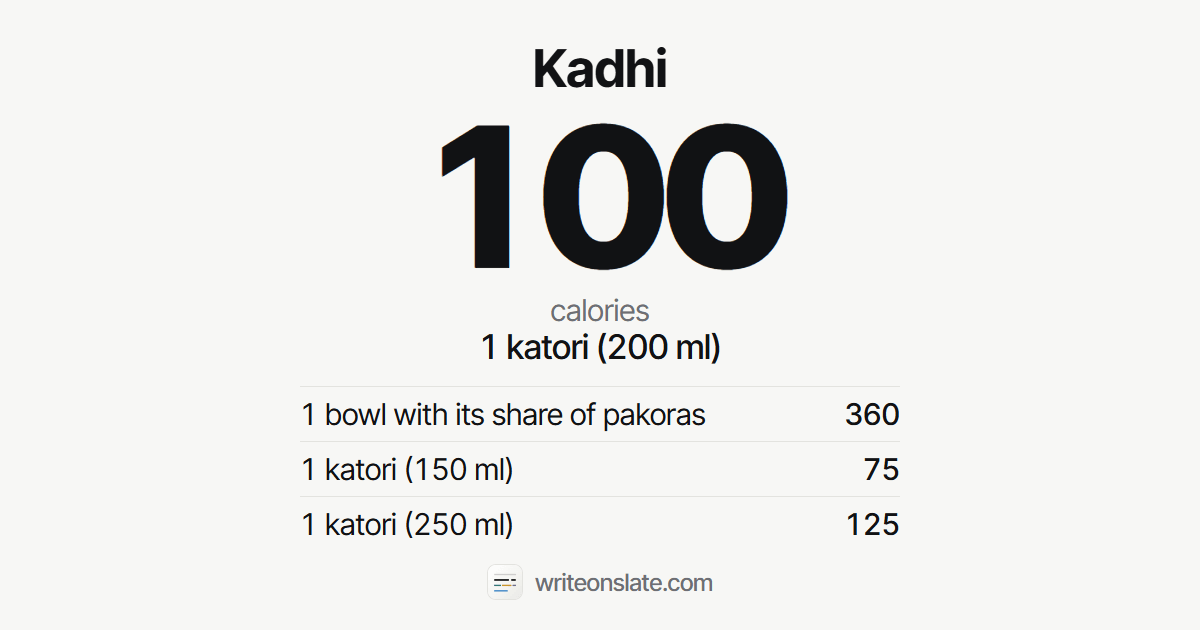
A 200 ml katori of kadhi without pakoras has about 100 calories, and kadhi with 2 rotis about 295. Pakoras change it most: a bowl with its share of fried pakoras is about 360, against 140 without. The tadka oil comes next, about 40 calories a teaspoon. Dhaba kadhi pakora, with more pakoras, runs about 360 to 465.
Kadhi is curd whisked with besan, simmered until it thickens and tempered with mustard or cumin, methi seeds, dry red chillies and curry leaves. Punjabi kadhi is thick and comes with fried besan pakoras; Gujarati kadhi is thin, white and a little sweet, eaten with khichdi.
The kadhi itself is light: mostly water and curd. The tadka oil and, above all, the fried pakoras are where most of the calories in a bowl of kadhi pakora come from.
Typical values for a home kitchen, for the portion named next to each number. Other sites often show bigger numbers because they count a bigger serving or a restaurant recipe. Your own katori, roti and oil change the number; Slate adjusts for them.
How many calories are in kadhi?
| Portion | Cals | Protein | Carbs | Fat |
|---|---|---|---|---|
| 1 katori (150 ml) about 150 g | 75 | 3 g | 5 g | 5 g |
| 1 katori (200 ml) about 200 g | 100 | 3 g | 6 g | 7 g |
| 1 katori (250 ml) about 250 g | 125 | 4 g | 8 g | 9 g |
| 1 bowl, half the recipe about 273 g | 140 | 5 g | 9 g | 9 g |
| 1 bowl with its share of pakoras | 360 | 8 g | 17 g | 29 g |
How does home kadhi compare with outside?
At a dhaba, kadhi pakora is usually served with more pakoras in a bigger bowl, and the pakoras are fried in oil that's been used many times.
The pakoras on this page already use the fat content of street pakoras measured in a lab, so the range below only allows for a serving up to 1.3 times as big.
| Version | Cals | Fat |
|---|---|---|
| Home | 360 | 29 g |
| Dhaba kadhi pakora | 360 to 465 | 29 to 38 g |
Calories in kadhi as a meal
| Portion | Cals | Protein | Carbs | Fat |
|---|---|---|---|---|
| Kadhi with rice (a katori of each) | 260 | 7 g | 42 g | 7 g |
| Kadhi with 2 rotis | 295 | 10 g | 45 g | 8 g |
What changes the calories in kadhi?
- Pakoras are the biggest variable. A bowl's share of fried pakoras adds more than the kadhi itself: about 360 for the bowl with them, against 140 without.
- The tadka oil is next: each teaspoon adds about 40 calories to the pot.
- Thin Gujarati kadhi has less besan per katori and often a teaspoon of sugar, about 16 calories.
- Full-fat curd and sour curd count about the same. Low-fat curd lowers it a little.
How were these numbers worked out?
Slate's kadhi comes from the besan kadhi with pakodies in The Art & Science of Cooking (via the Indian Nutrient Databank): 100 g of curd, 20 g of besan and 2 glasses of water for 2 bowls, with a tablespoon of oil in the tadka, counted as eaten, at IFCT 2017 values with curd and chilli powder from USDA. The ingredients added together weigh about 546 g, so the pot is 50 calories per 100 g and a 200 ml katori at 1 g per ml is 100. Instead of the databank's whole pan of pakora frying oil, this page takes the pakoras at 30.6% fat, the figure Gupta et al. measured in Delhi street pakoras, about 19 g of oil per bowl's share, so a bowl with pakoras is 360. No analysed kadhi exists in IFCT 2017, NIN or USDA FNDDS, so there is no cross-check. The dhaba range only allows a serving up to 1.3 times as big. Every dish on Slate is worked out the same way: how Slate counts calories.
| Ingredient | Raw | Values from |
|---|---|---|
| Curd (dahi), whole milk | 100 g | USDA FDC 171284 |
| Besan (ground Bengal gram dal) | 20 g | IFCT 2017 B001 |
| Water 2 glasses | 400 g | no calories |
| Groundnut oil 1 tablespoon, for the tadka | 13.6 g | IFCT 2017 T005 |
| Red chillies, dry, whole 2 dry red chillies | 6.7 g | IFCT 2017 G022 |
| Turmeric powder | 2.25 g | IFCT 2017 G033 |
| Fenugreek seeds (methi dana) | 1 g | IFCT 2017 G026 |
| Red chilli powder | 1 g | USDA FDC 171319 |
| Curry leaves | 1 g | IFCT 2017 G010 |
Sources
- ICMR-NIN, Indian Food Composition Tables 2017. Bengal gram dal (B001) for besan, spinach (C033), onion, red chillies (G022), turmeric, fenugreek seeds, curry leaves, oil; values read from github.com/nodef/ifct2017
- Vijayakumar et al., Indian Nutrient Databank (INDB), Current Developments in Nutrition, 2024. The Art & Science of Cooking recipe ASC168, besan kadhi with pakodies
- Gupta et al., Unhealthy fat in street and snack foods, Journal of Nutrition Education and Behavior, 2016. Measured pakora weight and fat, Delhi urban slum
- USDA FoodData Central, Yogurt, plain, whole milk (171284). Curd, since IFCT 2017 has no curd
- USDA FoodData Central, Spices, chili powder (171319). Red chilli powder
Questions people ask
How many calories are in kadhi without pakora?
About 100 in a 200 ml katori, and about 140 in a bowl of half this recipe.
How many calories are in kadhi pakora?
About 360 for a bowl with its share of pakoras. The pakoras are most of it.
How much protein is in kadhi?
About 5 g in a bowl without pakoras, from the curd and besan, and about 8 g with them.