
Roti calories
One medium roti made from about 30 g of atta has about 95 calories. Two medium rotis come to about 190. A teaspoon of ghee on top adds about 45, taking one roti to about 140. At a dhaba, where rotis are brushed with ghee and often bigger, a roti runs about 140 to 185.
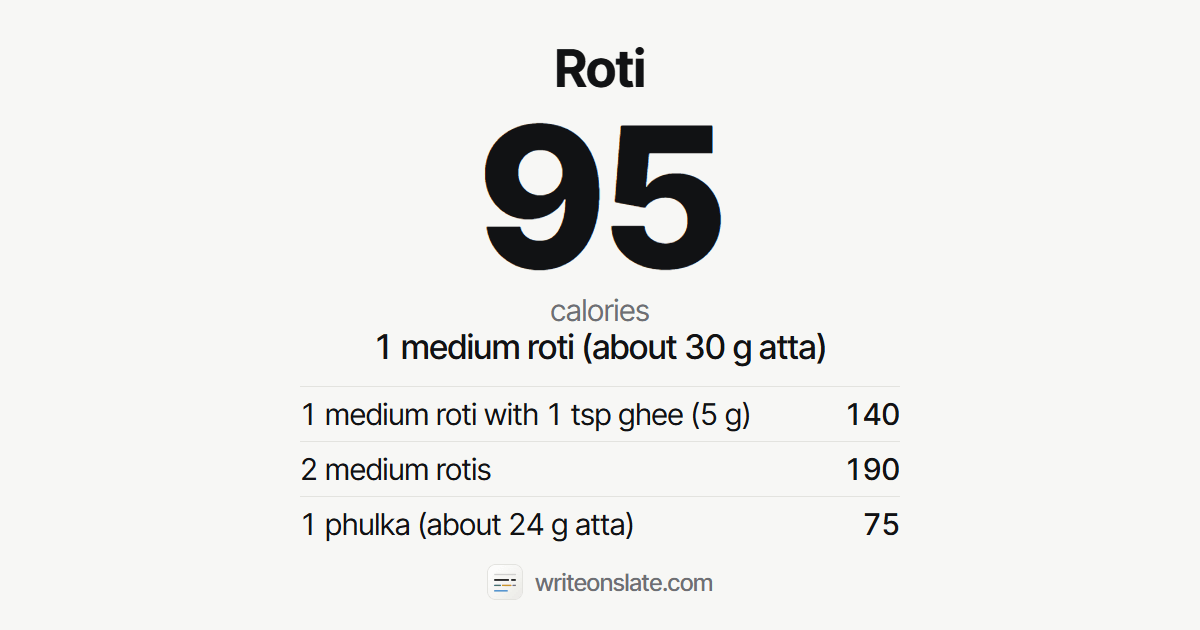
Roti, chapati and phulka are the same flatbread: whole-wheat atta and water, rolled out and cooked on a hot tawa. A phulka is held over an open flame at the end so it puffs. In Gujarat it's rotli, often smaller and thinner than a Punjabi roti.
A plain roti is almost all atta, so its calories follow the size of the dough ball. Ghee or butter on top is what usually raises the number.
Typical values for a home kitchen, for the portion named next to each number. Other sites often show bigger numbers because they count a bigger serving or a restaurant recipe. Your own katori, roti and oil change the number; Slate adjusts for them.
How many calories are in roti?
| Portion | Cals | Protein | Carbs | Fat |
|---|---|---|---|---|
| 1 phulka (about 24 g atta) about 32 g | 75 | 3 g | 15 g | 0 g |
| 1 medium roti (about 30 g atta) about 40 g | 95 | 3 g | 19 g | 0 g |
| 1 large roti (about 40 g atta) about 53 g | 130 | 4 g | 26 g | 1 g |
| 1 medium roti with 1 tsp ghee (5 g) about 40 g | 140 | 3 g | 19 g | 5 g |
| 2 medium rotis about 80 g | 190 | 6 g | 39 g | 1 g |
How does home roti compare with outside?
At home, most rotis reach the plate dry or with a little ghee. At a dhaba or in a restaurant they're often brushed with ghee or butter, and tandoori rotis are usually bigger, which adds more again.
No lab has published a figure for a restaurant roti, so the range below assumes a medium roti with 1 to 2 teaspoons of ghee.
| Version | Cals | Fat |
|---|---|---|
| Home | 95 | 0 g |
| Dhaba or restaurant, with ghee | 140 to 185 | 5 to 10 g |
Calories in roti as a meal
| Portion | Cals | Protein | Carbs | Fat |
|---|---|---|---|---|
| 2 rotis with ghee about 80 g | 280 | 6 g | 39 g | 11 g |
| 2 rotis and a katori of dal tadka | 305 | 10 g | 49 g | 7 g |
| 3 rotis and a katori of mixed veg | 435 | 14 g | 71 g | 10 g |
What changes the calories in roti?
- Calories follow the atta, so a roti rolled from a bigger dough ball counts for more, however thin it's rolled.
- A teaspoon of ghee or butter on top (5 g) adds about 45 calories, close to half a roti again.
- Some kitchens knead the atta with a spoon of oil, which spreads about 45 calories per teaspoon across the whole batch.
- These numbers are for whole-wheat atta. Rotis made with maida, or mixed with besan, bajra or jowar, have their own values.
- A phulka loses a little water over the flame, so it weighs less, but its calories stay with the atta.
How were these numbers worked out?
A roti on Slate is its share of 100 g of whole-wheat atta kneaded with about 70 g of water: a medium roti is 30 g of atta, a phulka about 24 g and a large roti 40 g, with no fat unless a row adds ghee. Atta and ghee are valued from IFCT 2017. The cooked weight comes from water content rather than a scale: IFCT's atta is about 11% water and USDA's cooked chapati about 33%, so a roti weighs 1.33 times its atta and cooked roti is about 240 calories per 100 g. As a check, ICMR-NIN lists one phulka at 80 calories, and 24 g of atta comes to 75 here, within 5%. No analysed value exists for a restaurant or tandoori roti, so the outside range is the same roti brushed with 1 to 2 teaspoons of ghee. Every dish on Slate is worked out the same way: how Slate counts calories.
| Ingredient | Raw | Values from |
|---|---|---|
| Wheat flour, atta | 100 g | IFCT 2017 A019 |
| Water About 70% of the flour weight, as in a published chapati study | 70 g | no calories |
Sources
- ICMR-NIN, Indian Food Composition Tables 2017. Atta (A019), ghee (T013); values read from the digitised tables at github.com/nodef/ifct2017
- ICMR-NIN, Dietary Guidelines for Indians: A Manual (2011). Annexure 8: phulka 80 kcal; teaspoon and cup sizes
- USDA FoodData Central 171844, chapati or roti, plain. Water content of cooked chapati (33 g per 100 g)
- Vijayakumar et al., Indian Nutrient Databank (INDB), Current Developments in Nutrition, 2024. Textbook chapati recipe, ASC096
- Khurshid et al., chapati quality study, Food Science and Biotechnology, 2020. Water at about 70% of flour weight
Questions people ask
How many calories are in 1 roti?
A medium roti made with about 30 g of atta has about 95 calories. A phulka is about 75, and a large roti about 130.
How many calories does ghee add to a roti?
One teaspoon of ghee (5 g) adds about 45 calories. A medium roti with a teaspoon of ghee comes to about 140.
Is a phulka different from a chapati?
They're made from the same dough. A phulka is puffed over an open flame and is usually smaller, so one phulka counts for less, but gram for gram of atta the calories are the same.
How many grams is one roti?
A medium roti made with 30 g of atta weighs about 40 g once cooked. Sizes vary a lot between kitchens, which is why Slate asks you for your roti size.
Which has fewer calories, roti or rice?
Per usual serving they're close: 2 medium rotis are about 190 calories, and a 200 ml katori of plain rice is about 160. Per 100 g, roti has more, because it holds less water: about 240 against about 120 for cooked rice.
How many calories are in 2 roti and dal?
About 305 calories for 2 medium rotis and a 200 ml katori of dal tadka, with about 10 g of protein.
How many calories are in 3 roti with sabzi?
About 435 calories with a 200 ml katori of mixed veg. With a teaspoon of ghee on each, 2 rotis alone come to about 280.