
Egg bhurji calories
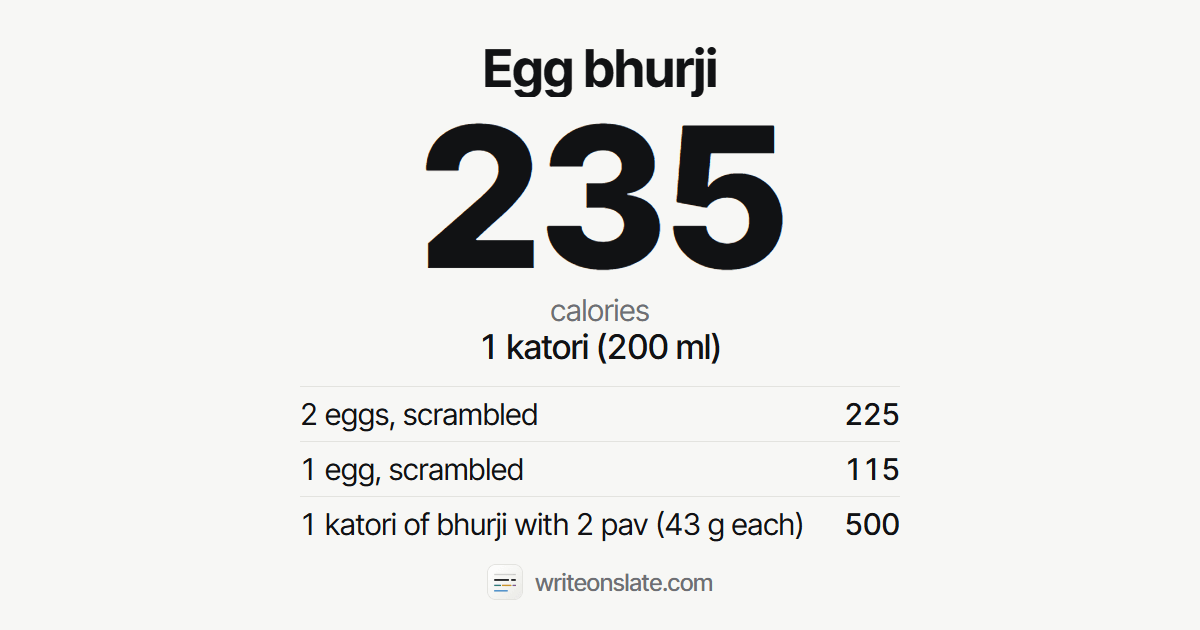
Home egg bhurji, one egg scrambled with a tablespoon of milk and a teaspoon of butter, has about 115 calories per egg, with 7 g of protein. Two eggs come to about 225, and a 200 ml katori, a little over 2 eggs, about 235. Stall anda bhurji, with more butter and onion and tomato, runs about 270 to 355 a katori.
Egg bhurji is scrambled egg the Indian way: eggs broken into a pan of onion, green chilli and tomato softened in butter or oil, stirred until they set in small pieces. It's a breakfast and tiffin dish at home and a late-night one at the anda bhurji cart, eaten with pav or roti.
The textbook version counted here is plain scrambled egg with butter. Onion and tomato add little; the butter or oil in the pan is what moves the number.
Typical values for a home kitchen, for the portion named next to each number. Other sites often show bigger numbers because they count a bigger serving or a restaurant recipe. Your own katori, roti and oil change the number; Slate adjusts for them.
How many calories are in egg bhurji?
| Portion | Cals | Protein | Carbs | Fat |
|---|---|---|---|---|
| 1 katori (200 ml) about 114 g | 235 | 15 g | 2 g | 19 g |
| 1 egg, scrambled about 55 g | 115 | 7 g | 1 g | 9 g |
| 2 eggs, scrambled about 110 g | 225 | 14 g | 2 g | 18 g |
| 1 katori of bhurji with 2 pav (43 g each) about 114 g | 500 | 24 g | 45 g | 24 g |
How does home egg bhurji compare with outside?
Anda bhurji from a cart or dhaba is cooked in a lot more butter or oil than this, usually with a good amount of onion, tomato and masala, and served with 2 pav that are often buttered too.
No lab has measured a stall bhurji, so the range below allows 1.5 to 2.5 times this recipe's butter per katori, plus the onion and tomato. The pav are extra: see the table above.
| Version | Cals | Fat |
|---|---|---|
| Home | 235 | 19 g |
| Anda bhurji stall or dhaba | 270 to 355 | 23 to 31 g |
Calories in egg bhurji as a meal
| Portion | Cals | Protein | Carbs | Fat |
|---|---|---|---|---|
| Egg bhurji with 2 rotis | 425 | 21 g | 40 g | 20 g |
What changes the calories in egg bhurji?
- The butter or oil. This recipe uses a teaspoon of butter per egg; a second teaspoon adds about 35 calories.
- The number of eggs: about 115 for one egg, 225 for two.
- Pav or roti on the side. A katori of bhurji with 2 plain pav is about 500; with 2 medium rotis, about 425.
- Onion, tomato and green chilli add about 10 calories for 50 g. Cheese on top adds far more.
- Milk makes the bhurji softer and adds about 73 calories per 100 ml, so a tablespoon is about 10.
How were these numbers worked out?
The recipe is the ande ki bhurji in The Art & Science of Cooking (via the Indian Nutrient Databank): one egg scrambled with a tablespoon of milk, a teaspoon of butter and pepper, the butter counted as eaten. Egg, milk and pepper are IFCT 2017 values; butter is USDA's, since IFCT has no butter; the pav is IFCT's bread at 43 g. The cooked weight is USDA's 55 g per scrambled egg, so one egg of bhurji is 115 calories and 205 per 100 g; a katori is filled at 0.57 g per ml, USDA's 135 g per cup of scrambled egg, so a 200 ml katori holds about 114 g, a little over 2 eggs, and 235 calories. USDA's analysed scrambled egg made with butter, 182 calories per 100 g, is 12% below. No stall bhurji has been analysed; the range uses 1.5 to 2.5 times the butter with up to 25 g each of onion and tomato. Every dish on Slate is worked out the same way: how Slate counts calories.
| Ingredient | Raw | Values from |
|---|---|---|
| Egg, hen, whole, raw 1 egg | 50 g | IFCT 2017 M001 |
| Milk, whole, cow 1 tablespoon | 15 g | IFCT 2017 L002 |
| Butter 1 teaspoon | 4.7 g | USDA FDC 173430 |
| Black pepper to taste | 0.5 g | IFCT 2017 G031 |
Sources
- ICMR-NIN, Indian Food Composition Tables 2017. Egg (M001), milk, whole, cow (L002), black pepper (G031), and bread for the pav as on the site's vada pav page; values read from github.com/nodef/ifct2017
- USDA FoodData Central, Butter, without salt (173430). 717 kcal and 81 g fat per 100 g; 1 teaspoon = 4.7 g
- Vijayakumar et al., Indian Nutrient Databank (INDB), Current Developments in Nutrition, 2024. The Art & Science of Cooking recipe ASC059, scrambled egg (ande ki bhurji)
- USDA FoodData Central, FNDDS Egg omelet or scrambled egg, made with butter (2707201). 182 kcal per 100 g; 1 egg = 55 g; 1 cup = 135 g
Questions people ask
How many calories are in egg bhurji?
About 115 per egg made with a teaspoon of butter, 225 for 2 eggs, and 235 in a 200 ml katori.
How many calories are in 2 egg bhurji?
About 225 calories, with 14 g of protein and 18 g of fat.
How many calories are in anda bhurji with pav?
About 500 for a 200 ml katori of bhurji with 2 plain pav of 43 g each. Buttered pav and a stall's extra butter push it higher: see the outside range.
How much protein is in egg bhurji?
About 7 g per egg and 15 g in a 200 ml katori. With 2 rotis it's about 21 g.
Which has more calories, egg bhurji or an omelette?
Per egg they are close: about 115 for bhurji with a teaspoon of butter, against about 105 for a single-egg omelette cooked in oil.