
Veg biryani calories
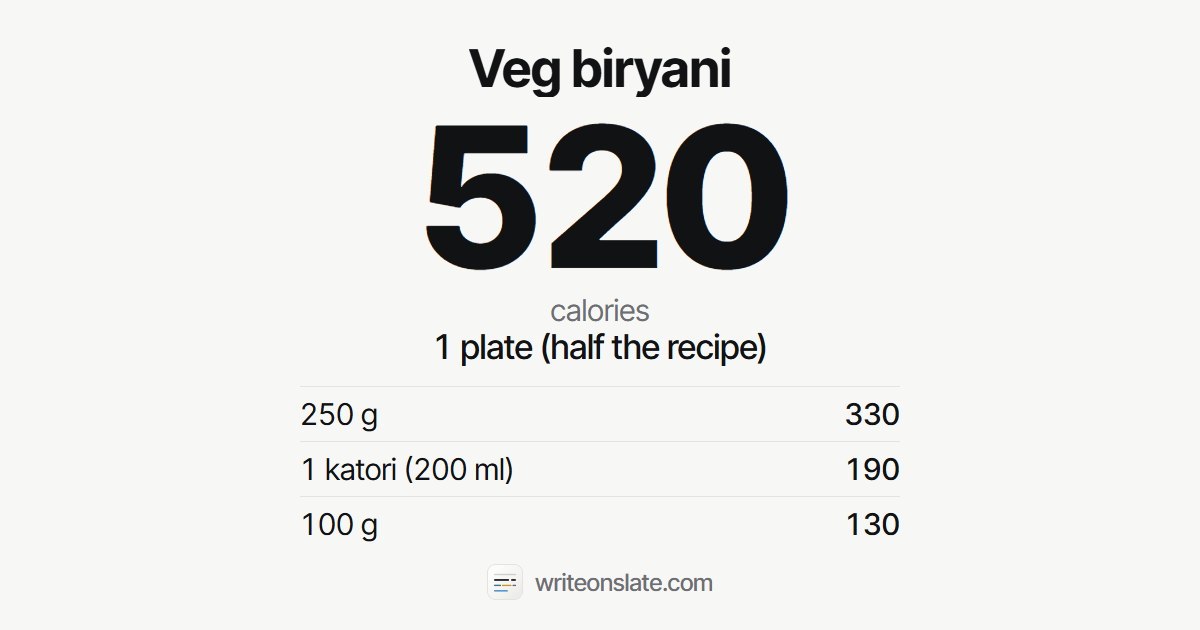
A plate of veg biryani from 50 g of raw rice, about 397 g cooked, has about 520 calories. A 200 ml katori is about 190, and 250 g about 330. Oil or ghee matters most: each tablespoon in the pot adds about 60 calories to each plate. A restaurant or delivery plate, bigger, runs about 520 to 780.
Veg biryani is rice parboiled with whole spices and layered with a masala of vegetables, fried onion, curd and saffron milk, then cooked on dum. Hyderabadi, Lucknowi and Kolkata styles differ in spice and richness, and many homes make a quicker one-pot version.
This textbook biryani uses 4 tablespoons of oil for two plates, so oil is close to half of its calories. That's the number to watch.
Typical values for a home kitchen, for the portion named next to each number. Other sites often show bigger numbers because they count a bigger serving or a restaurant recipe. Your own katori, roti and oil change the number; Slate adjusts for them.
How many calories are in veg biryani?
| Portion | Cals | Protein | Carbs | Fat |
|---|---|---|---|---|
| 1 katori (200 ml) about 145 g | 190 | 3 g | 20 g | 11 g |
| 1 plate (half the recipe) about 397 g | 520 | 9 g | 55 g | 29 g |
| 100 g about 100 g | 130 | 2 g | 14 g | 7 g |
| 250 g about 250 g | 330 | 6 g | 35 g | 18 g |
| 500 g about 500 g | 655 | 12 g | 69 g | 36 g |
How does home veg biryani compare with outside?
Restaurant and delivery biryani portions are often bigger than a home plate, and some are finished with ghee or fried onions on top.
This textbook recipe already uses a lot of oil, so the range below only allows for a plate up to 1.5 times as big.
| Version | Cals | Fat |
|---|---|---|
| Home | 520 | 29 g |
| Restaurant or delivery | 520 to 780 | 29 to 43 g |
Calories in veg biryani as a meal
| Portion | Cals | Protein | Carbs | Fat |
|---|---|---|---|---|
| Half a plate of veg biryani about 198 g | 260 | 5 g | 27 g | 14 g |
What changes the calories in veg biryani?
- Oil or ghee is the biggest variable. Each tablespoon across the pot adds about 120 calories, about 60 to each plate.
- Fried onions (birista) take up oil. Shop-bought fried onions count as well.
- More rice and fewer vegetables raises the number per plate; more vegetables lowers it.
- Raita and salan are separate. A 200 ml katori of cucumber raita is about 95 calories.
How were these numbers worked out?
The recipe is the vegetable biryani in The Art & Science of Cooking (via the Indian Nutrient Databank): 100 g of rice, 300 g of potato, peas, carrot, cauliflower, beans and tomato, 100 g of onion, curd, saffron milk and 4 tablespoons of oil, for 2 plates, every gram of oil counted, at IFCT 2017 values. The rice is taken at 2.98 times its raw weight once cooked, as on the plain rice page, and the rest at raw weight, about 793 g in all, so a plate is half the recipe, 520 calories, and the pot 130 per 100 g; a 200 ml katori at USDA's 172 g per cup for vegetable biryani is 190. The one analysed value, USDA's survey biryani with vegetables at 109 calories per 100 g, is 17% below this oil-heavy textbook recipe, so the page shows a range. Because the recipe already uses so much oil, the restaurant range only runs the plate up to 1.5 times as big. Every dish on Slate is worked out the same way: how Slate counts calories.
| Ingredient | Raw | Values from |
|---|---|---|
| Rice, parboiled, milled | 100 g | IFCT 2017 A014 |
| Water Taken up by the rice: cooked rice is 2.98 times raw | 198 g | no calories |
| Potato, brown skin, big | 50 g | IFCT 2017 F006 |
| Peas, fresh | 50 g | IFCT 2017 D061 |
| Carrot, orange | 50 g | IFCT 2017 F002 |
| Cauliflower | 50 g | IFCT 2017 D036 |
| French beans | 50 g | IFCT 2017 D049 |
| Tomato, ripe, hybrid | 50 g | IFCT 2017 D075 |
| Onion, big | 100 g | IFCT 2017 G017 |
| Ginger, fresh | 6.3 g | IFCT 2017 G014 |
| Garlic | 2.2 g | IFCT 2017 G011 |
| Milk, whole, cow 1 tablespoon, for the saffron | 15 g | IFCT 2017 L002 |
| Curd (dahi), whole milk 1 tablespoon | 15 g | USDA FDC 171284 |
| Cumin seeds | 1 g | IFCT 2017 G025 |
| Red chilli powder | 1.35 g | USDA FDC 171319 |
| Groundnut oil 4 tablespoons | 54.4 g | IFCT 2017 T005 |
USDA's survey value for vegetable biryani is about 109 calories per 100 g, below this page's 130, because it uses less oil. Home biryani made with less oil can be about a fifth lower than the figures here.
Sources
- ICMR-NIN, Indian Food Composition Tables 2017. Rice parboiled (A014), potato, peas, carrot, cauliflower (D036), French beans (D049), tomato, onion, ginger, garlic, cow milk, cumin, oil; values read from github.com/nodef/ifct2017
- Vijayakumar et al., Indian Nutrient Databank (INDB), Current Developments in Nutrition, 2024. The Art & Science of Cooking recipe ASC123, vegetable biryani
- USDA FoodData Central, FNDDS Biryani with vegetables (2708985). 109 kcal per 100 g; 172 g per cup
- Bognár, Tables on weight yield of food and retention factors of food constituents, BFE 2002. Rice yield 2.98
- USDA FoodData Central, Yogurt, plain, whole milk (171284). Curd
Questions people ask
How many calories are in 1 plate of veg biryani?
About 520 for a home plate made from 50 g of raw rice with vegetables, about 395 g cooked.
How many calories are in 250 g of veg biryani?
About 330, and about 655 for 500 g.
How much protein is in veg biryani?
About 9 g in a plate, from the rice, peas and curd.
Which has more calories, veg biryani or chicken biryani?
It depends on the oil more than the chicken. In these two textbook recipes the veg biryani uses far more oil, so a plate is about 520 against about 385 for chicken biryani.
How many calories are in half a plate of veg biryani?
About 260 calories, with about 5 g of protein. A full plate is about 520.