
Sambar calories
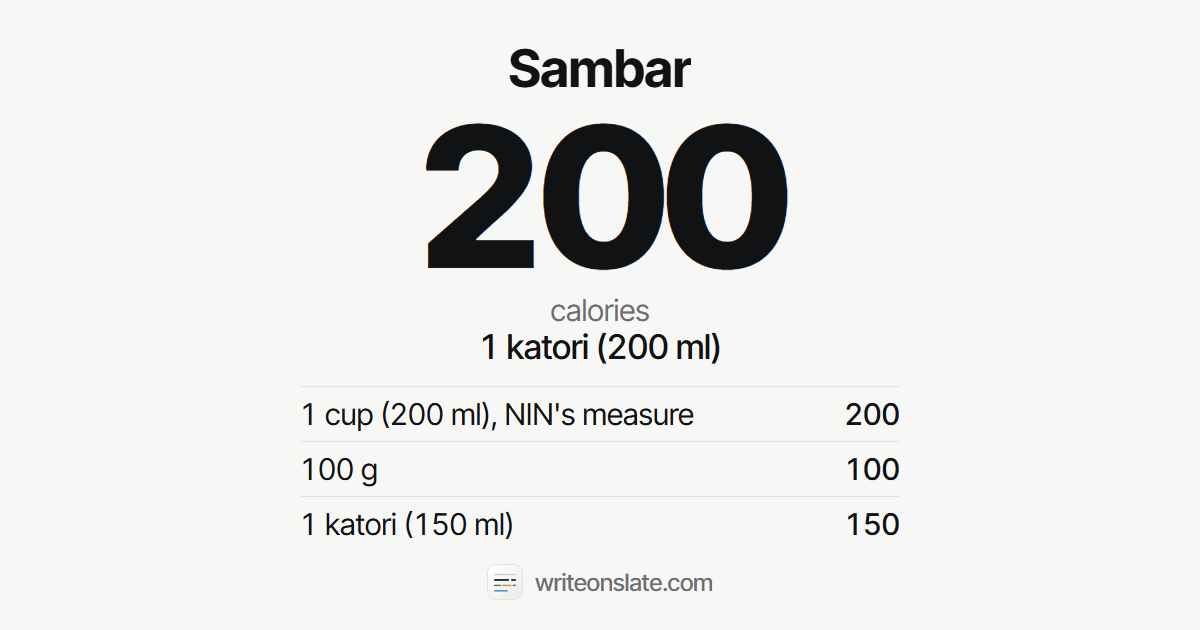
A 200 ml katori of thick sambar made with coconut has about 200 calories. A thinner everyday sambar without coconut is closer to 110, ICMR-NIN's figure for a cup. Coconut is the biggest single variable: the 30 g here adds about 120 calories to the pot. Udupi restaurant or canteen sambar runs about 120 to 200 a katori.
Sambar is toor dal cooked with tamarind, sambar powder and vegetables such as drumstick, brinjal, okra and shallots, tempered with mustard seeds and curry leaves. It's eaten across south India with rice, idli, dosa and vada, and every state and family makes it differently.
This textbook sambar grinds roasted coconut into the masala, as in many Kerala and Udupi homes. The coconut is about a quarter of its calories, so whether yours has it matters.
Typical values for a home kitchen, for the portion named next to each number. Other sites often show bigger numbers because they count a bigger serving or a restaurant recipe. Your own katori, roti and oil change the number; Slate adjusts for them.
How many calories are in sambar?
| Portion | Cals | Protein | Carbs | Fat |
|---|---|---|---|---|
| 1 katori (150 ml) about 150 g | 150 | 5 g | 16 g | 7 g |
| 1 katori (200 ml) about 200 g | 200 | 7 g | 22 g | 9 g |
| 1 katori (250 ml) about 250 g | 250 | 9 g | 27 g | 11 g |
| 1 cup (200 ml), NIN's measure about 200 g | 200 | 7 g | 22 g | 9 g |
| 1 bowl, half the recipe about 258 g | 260 | 9 g | 28 g | 12 g |
| 100 g about 100 g | 100 | 4 g | 11 g | 5 g |
How does home sambar compare with outside?
Sambar from an Udupi restaurant or an office canteen is usually thinner than this textbook one and refilled freely, so the katori matters less than how many you have.
We found no lab figure for restaurant sambar, so the range below runs from a thinner sambar, close to ICMR-NIN's 110 calories a cup, up to one as thick as this.
| Version | Cals | Fat |
|---|---|---|
| Home | 200 | 9 g |
| Udupi restaurant or canteen | 120 to 200 | 5 to 9 g |
What changes the calories in sambar?
- Coconut is the biggest single variable. The 30 g of fresh coconut here adds about 120 calories to the pot, about a quarter of the total.
- Thickness decides how much dal is in a katori. A thin, everyday sambar has about half of this one per katori.
- The tadka oil adds about 40 calories a teaspoon to the pot. Some homes finish with a spoon of ghee.
- Vegetables add little: drumstick, brinjal, okra and tomato together are about 30 calories in the whole pot.
How were these numbers worked out?
The sambar is the one in The Art & Science of Cooking (via the Indian Nutrient Databank): 50 g of toor dal with a teaspoon each of roasted chana and urad dal, 30 g of fresh coconut, tamarind, drumstick, brinjal, okra, tomato and onion, cooked in a cup of water with 2 teaspoons of oil, for 2 bowls, at IFCT 2017 values with the oil counted. The ingredients added together weigh about 515 g, so the pot is 100 calories per 100 g and a 200 ml katori at 1 g per ml is 200. This is a thick, coconut sambar: ICMR-NIN's cup of sambar is 110 calories, 45% below, and USDA's survey sambar 86 per 100 g, 14% below, so the page shows a range. Restaurant sambar served with idli and dosa is thinner, so the outside range runs from 0.6 to 1 times this one, the low end near NIN's figure. Every dish on Slate is worked out the same way: how Slate counts calories.
| Ingredient | Raw | Values from |
|---|---|---|
| Red gram dal (toor, arhar) | 50 g | IFCT 2017 B021 |
| Bengal gram dal (chana) 1 teaspoon, roasted for the masala | 4 g | IFCT 2017 B001 |
| Black gram dal (urad) 1 teaspoon, roasted for the masala | 4 g | IFCT 2017 B003 |
| Coconut, fresh | 30 g | IFCT 2017 H007 |
| Tamarind pulp | 20 g | IFCT 2017 E064 |
| Drumstick (moringa pods) | 30 g | IFCT 2017 D046 |
| Brinjal (baingan), all varieties | 30 g | IFCT 2017 D031 |
| Ladies finger (bhindi) | 30 g | IFCT 2017 D056 |
| Tomato, ripe, hybrid | 30 g | IFCT 2017 D075 |
| Onion, big | 30 g | IFCT 2017 G017 |
| Red chillies, dry, whole | 5 g | IFCT 2017 G022 |
| Coriander seeds (dhania) | 1.8 g | IFCT 2017 G024 |
| Fenugreek seeds (methi dana) | 1 g | IFCT 2017 G026 |
| Turmeric powder | 0.75 g | IFCT 2017 G033 |
| Groundnut oil 2 teaspoons | 9 g | IFCT 2017 T005 |
| Water 1 cup | 240 g | no calories |
ICMR-NIN counts a cup of sambar at 110 calories, about half this page's 200. Most of the difference is thickness and the coconut. Depending on how it's made, a 200 ml katori of sambar can be anywhere from about 110 to 200.
Sources
- ICMR-NIN, Indian Food Composition Tables 2017. Red gram dal (B021), Bengal gram dal, black gram dal, coconut fresh (H007), tamarind pulp (E064), drumstick (D046), brinjal (D031), ladies finger (D056), tomato, onion, red chillies (G022), spices, oil; values read from github.com/nodef/ifct2017
- Vijayakumar et al., Indian Nutrient Databank (INDB), Current Developments in Nutrition, 2024. The Art & Science of Cooking recipe ASC167, sambar
- ICMR-NIN, Dietary Guidelines for Indians: A Manual (2011). Annexure 8: sambar 110 kcal per cup; cup = 200 ml
- USDA FoodData Central, FNDDS Sambar, vegetable stew (2707430). 86 kcal per 100 g
Questions people ask
How many calories are in 1 cup of sambar?
About 110 for a thin everyday sambar, ICMR-NIN's figure, and about 200 for this thick sambar with coconut.
How many calories are in idli sambar?
About 305 calories for 2 medium idlis with a 200 ml katori of this sambar; a thinner sambar brings it down. The idli sambar page has 1 to 4 idlis and the restaurant range.
How much protein is in sambar?
About 7 g in a 200 ml katori of this sambar, mostly from the toor dal.
How many calories are in 100 g of sambar?
About 100 for this thick sambar with coconut, and about 55 for a thin one. USDA's survey value is 86.
Which has more calories, sambar or rasam?
Sambar, by a lot. Rasam has very little dal and no coconut: a 200 ml katori of rasam is about 50 calories.