
Plain dosa calories
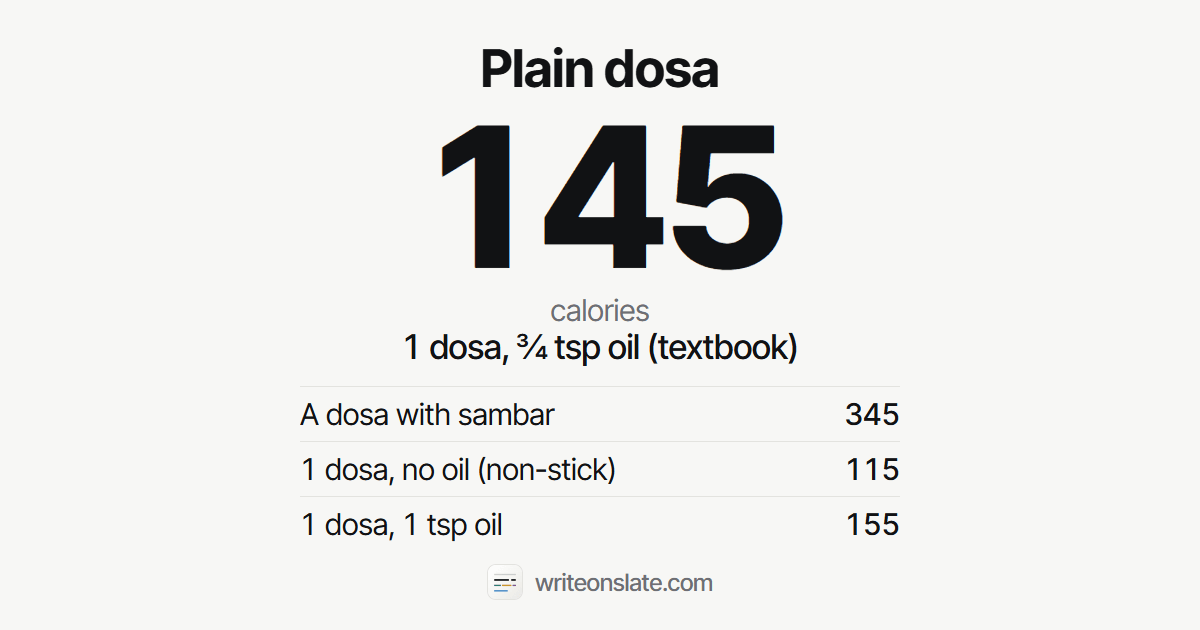
One plain dosa (about 33 g of rice and urad dal, ¾ teaspoon of oil) has about 145 calories, or about 115 with no oil on a non-stick tawa. Two dosas are about 285; one with sambar about 345. Tawa fat matters most, about 40 calories a teaspoon. A restaurant or paper dosa, much bigger, runs about 145 to 310.
A plain dosa is a fermented batter of rice and urad dal, spread thin on a hot tawa and cooked with a little oil, ghee or butter until crisp. It's eaten across south India for breakfast and dinner, with sambar and coconut chutney, and paper dosa is the same batter spread larger and thinner.
The batter is mostly rice. Without any fat a dosa is about 115 calories; the oil or ghee on the tawa is what moves it from there.
Typical values for a home kitchen, for the portion named next to each number. Other sites often show bigger numbers because they count a bigger serving or a restaurant recipe. Your own katori, roti and oil change the number; Slate adjusts for them.
How many calories are in plain dosa?
| Portion | Cals | Protein | Carbs | Fat |
|---|---|---|---|---|
| 1 dosa, no oil (non-stick) | 115 | 4 g | 23 g | 0 g |
| 1 dosa, ¾ tsp oil (textbook) | 145 | 4 g | 23 g | 4 g |
| 1 dosa, 1 tsp oil | 155 | 4 g | 23 g | 5 g |
| 1 dosa, 1 tsp ghee | 160 | 4 g | 23 g | 5 g |
| 2 dosas, ¾ tsp oil each | 285 | 8 g | 47 g | 7 g |
How does home plain dosa compare with outside?
Restaurant plain dosas and paper dosas are often much bigger than home ones, and many places finish them with butter or ghee. USDA's survey data lists dosas from 35 g for a small one to 155 g for a large one.
The range below runs from a dosa like this one up to one about 1.9 times the size, with up to a teaspoon of butter on top.
| Version | Cals | Fat |
|---|---|---|
| Home | 145 | 4 g |
| Restaurant or paper dosa | 145 to 310 | 4 to 11 g |
Calories in plain dosa as a meal
| Portion | Cals | Protein | Carbs | Fat |
|---|---|---|---|---|
| A dosa with sambar | 345 | 11 g | 45 g | 13 g |
What changes the calories in plain dosa?
- Fat on the tawa is the biggest variable. Each teaspoon of oil adds about 40 calories, and a teaspoon of ghee about 45.
- A bigger or thicker dosa uses more batter. Paper dosa is thin but large, so it often has more than a home dosa.
- Sambar and chutney are separate dishes. ICMR-NIN counts a cup of sambar at about 110 calories and 2 tablespoons of coconut chutney at about 120.
- Rava dosa, neer dosa and pesarattu use different batters and have their own values. Masala dosa adds a potato filling: see masala dosa.
How were these numbers worked out?
The dosa is the plain dosa in Basic Food Preparation (via the Indian Nutrient Databank): 50 g of raw rice, 50 g of parboiled rice, 30 g of urad dal and a little fenugreek, making 4, cooked with a tablespoon of oil between them, about three quarters of a teaspoon each, at IFCT 2017 values. Fermenting and cooking change the water in the batter, not the calories, so each dosa is a quarter of the batter plus the fat on the tawa, counted in full: 115 calories with no oil, 145 with the textbook's amount. The two checks pull apart, ICMR-NIN's dosa at 125 calories 13% below and USDA's 80 g medium dosa at 168 calories 17% above, so the page shows a range; the difference is size. The restaurant range runs to USDA's large 155 g dosa, 1.9 times a medium one, with up to a teaspoon of butter. Every dish on Slate is worked out the same way: how Slate counts calories.
| Ingredient | Raw | Values from |
|---|---|---|
| Rice, raw, milled | 50 g | IFCT 2017 A015 |
| Rice, parboiled, milled | 50 g | IFCT 2017 A014 |
| Black gram dal (urad) | 30 g | IFCT 2017 B003 |
| Fenugreek seeds (methi dana) a quarter teaspoon | 1 g | IFCT 2017 G026 |
Published figures for one dosa differ because dosas differ in size. ICMR-NIN counts a dosa at 125 calories, and USDA's survey data puts a medium 80 g dosa at about 170. A home plain dosa usually lands between 115 and 170, depending on size and oil.
Sources
- ICMR-NIN, Indian Food Composition Tables 2017. Rice raw (A015), rice parboiled (A014), black gram dal (B003), fenugreek seeds (G026), oil, ghee; values read from github.com/nodef/ifct2017
- Vijayakumar et al., Indian Nutrient Databank (INDB), Current Developments in Nutrition, 2024. Basic Food Preparation recipe BFP148, plain dosa
- ICMR-NIN, Dietary Guidelines for Indians: A Manual (2011). Annexure 8: dosa 125 kcal, sambar 110 kcal per cup, coconut chutney 120 kcal per 2 tbsp
- USDA FoodData Central, FNDDS Dosa, plain (2708347). Small 35 g, medium 80 g, large 155 g; 210 kcal per 100 g
- USDA FoodData Central, Butter, without salt (173430). Butter on restaurant dosas
Questions people ask
How many calories are in 1 plain dosa?
About 145 for a home dosa cooked with ¾ teaspoon of oil, and about 115 without oil. A large restaurant dosa can be close to twice that.
How many calories are in a dosa with ghee?
About 160 with a teaspoon of ghee on the tawa.
How many calories are in dosa with sambar and chutney?
Add them separately. ICMR-NIN counts a cup of sambar at about 110 calories and 2 tablespoons of coconut chutney at about 120, so a dosa with both is about 375 to 400.
Which has fewer calories, dosa or idli?
Per piece, an idli at about 50 calories, because a dosa uses more batter and is cooked with oil. Two idlis are about 105, a little less than one dosa.
How much protein is in a plain dosa?
About 4 g, from the rice and urad dal. Sambar adds a few grams more.
How many calories are in dosa with sambar?
About 345 calories for one dosa and a 200 ml katori of sambar, with about 11 g of protein.