
Peda calories
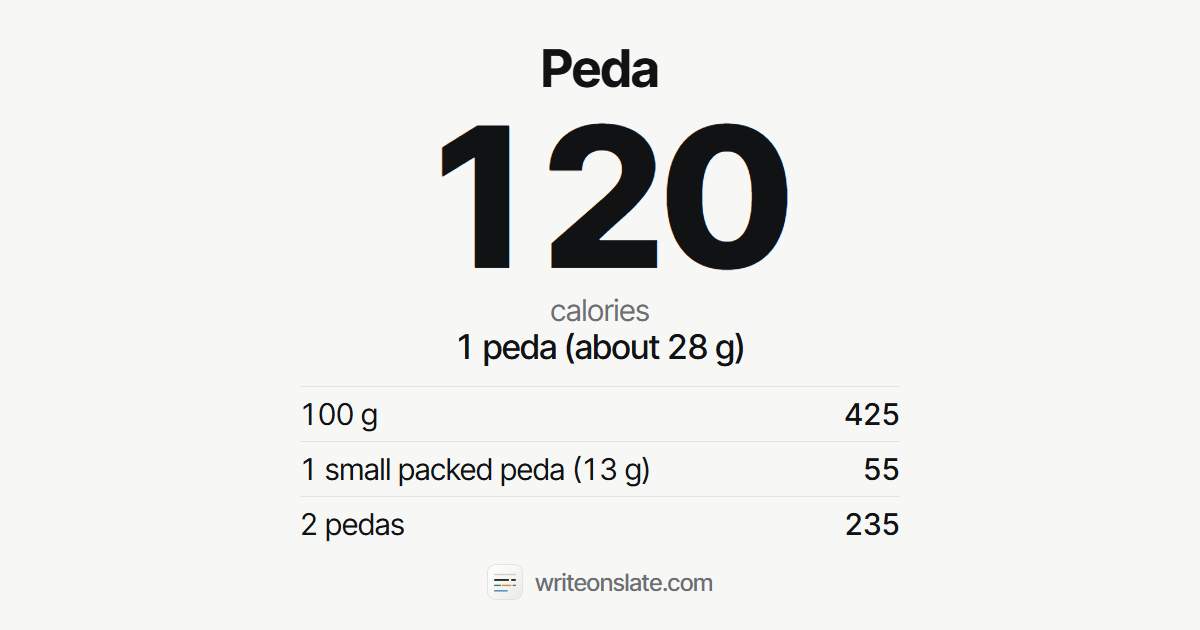
One peda of about 28 g, khoa cooked with sugar, has about 120 calories; 2 about 235. A small packed peda of 13 g is about 55. Khoa is two thirds of the calories and sugar nearly all the rest. Every sweet shop makes it the same way, so only the size moves the number: 100 g is about 425.
Peda is khoa, milk reduced to solids, cooked with sugar until it holds together, then pressed into a disc and stamped. Mathura's is caramelised brown, Dharwad's darker still, and the plain white doodh peda is the one in most sweet boxes. It is the simplest of the khoa sweets, with burfi and milk cake as close relations.
Because it is only khoa and sugar, the recipe hardly varies between homes and shops. A lab survey of market pedas and a packed label both land within 5% of this page per gram.
Typical values for a home kitchen, for the portion named next to each number. Other sites often show bigger numbers because they count a bigger serving or a restaurant recipe. Your own katori, roti and oil change the number; Slate adjusts for them.
How many calories are in peda?
| Portion | Cals | Protein | Carbs | Fat |
|---|---|---|---|---|
| 1 peda (about 28 g) about 28 g | 120 | 4 g | 13 g | 6 g |
| 1 small packed peda (13 g) about 13 g | 55 | 2 g | 6 g | 3 g |
| 2 pedas about 56 g | 235 | 9 g | 26 g | 11 g |
| 100 g about 100 g | 425 | 15 g | 47 g | 20 g |
What changes the calories in peda?
- Size is the only real variable: packed pedas run about 13 g, a halwai's 20 to 30 g, a Mathura peda up to 35 g.
- Sugar share: market pedas run from 32% to 62% sugar. Sugar and khoa are close per gram (387 and 316 calories per 100 g), so a sweeter peda is a few percent more, not a lot.
- Malai or kesar peda made with cream or extra ghee is a little richer; a drier, longer-cooked Mathura peda a little more per gram because there is less water.
- Kaju katli is richer per gram, about 505 per 100 g, but its pieces are smaller.
- Pista or silver leaf on top adds nothing you can measure.
How were these numbers worked out?
The recipe is the plain burfi in The Art & Science of Cooking (via the Indian Nutrient Databank): 100 g of khoa cooked with 35 g of castor sugar and 2 teaspoons of milk, with 2 almonds on top, making 4; peda and plain khoa burfi are the same mixture shaped differently. IFCT 2017 supplies the values, with sugar from USDA. The finished weight is set at the 13.6% moisture a National Dairy Research Institute survey measured in market pedas, about 111 g for 4, which puts the batch at 425 calories per 100 g and one peda at about 28 g and 120 calories. Two checks agree: the survey's mean composition gives 419 calories per 100 g, within 1%, and a packed peda label 442, within 4%. No outside range is shown, since only the piece size differs between shops and packs. Every dish on Slate is worked out the same way: how Slate counts calories.
| Ingredient | Raw | Values from |
|---|---|---|
| Khoa (mawa) | 100 g | IFCT 2017 L004 |
| Sugar, white castor sugar | 35 g | USDA FDC 169655 |
| Milk, whole, cow 2 teaspoons | 10 g | IFCT 2017 L002 |
| Almond 2, on top | 2.2 g | IFCT 2017 H001 |
Sources
- ICMR-NIN, Indian Food Composition Tables 2017. Khoa (L004), cow milk (L002), almond (H001); values read from github.com/nodef/ifct2017
- Vijayakumar et al., Indian Nutrient Databank (INDB), Current Developments in Nutrition, 2024. The Art & Science of Cooking recipe ASC335, plain burfi, 2 servings of 2 burfis; BFP404 khoa ladoo checked and not used
- Indian Nutrient Databank, recipes.xlsx, recipes_servingsize.xlsx and INDB.xlsx (GitHub). Recipe rows and serving count for ASC335
- Anuja C. Vasu, Distinct features and characteristics of Dharwad peda, MSc thesis, National Dairy Research Institute, Bangalore, 2007 (Krishikosh). Market pedas of other varieties: fat 16.74 ± 2.80, protein 15.23 ± 1.70, lactose 17.43 ± 1.83, sucrose 34.38 ± 6.42, ash 2.89, moisture 13.63 ± 1.66%; Dharwad peda: fat 14.21, protein 14.17, sucrose 38.97, moisture 13.33%
- NIFTEM, PM FME scheme, Peda processing (slide deck). Laboratory-prepared peda, average: moisture 10.2, fat 20.1, protein 19.0, lactose 18.3, sucrose 30.0%; market range: fat 3.5 to 25, sucrose 31.8 to 61.8%
- Rajhans peda label (Open Food Facts, 8908000716476). 13 g serving; 442 kcal, 22 g fat, 47.5 g carbohydrate, 13 g protein per 100 g; ingredients milk solids, sugar, cardamom
- USDA FoodData Central, Sugars, granulated (169655). Sugar; a teaspoon is 4.2 g and a cup 200 g
Questions people ask
How many calories are in 1 peda?
About 120 for a 28 g peda, and about 55 for a small 13 g packed one.
How many calories are in 2 pedas?
About 235 for two 28 g pedas.
How many calories are in 100 g of peda?
About 425. A packed label (Rajhans) lists 442, and a lab survey of market pedas works out to about 419.
How much sugar is in a peda?
About 9 g of added sugar in a 28 g peda, plus about 4 g of the milk's own sugar from the khoa.
Which has more calories, peda or kaju katli?
Per piece the peda, about 120 against about 50 for a 10 g sweet-shop kaju katli. Per 100 g the kaju katli, about 505 against 425, because cashews are richer than khoa.