
Fish curry calories
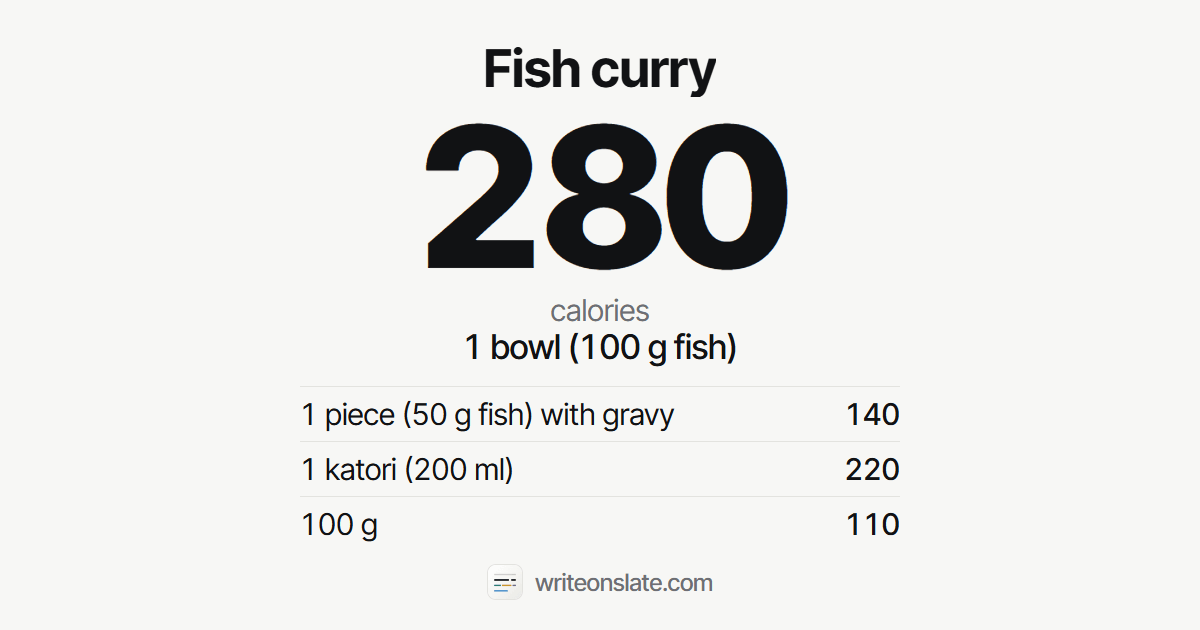
A bowl of home fish curry with 100 g of fish has about 280 calories, and one 50 g piece about 140. A 200 ml katori is about 220. Oil matters most, about 40 a teaspoon, and coconut milk adds about 140 per 60 g. Restaurant or coconut-based fish curry runs about 280 to 475 a bowl.
Fish curry is cooked all along India's coasts and rivers: Bengali machher jhol with rohu or katla and mustard oil, Goan and Kerala curries with coconut and kokum or tamarind, and north Indian onion-tomato gravies. This page uses a textbook onion-tomato curry with rohu.
Rohu and similar river fish are lean, about 2% fat, so most of this curry's fat is the oil. Coconut-based curries add a lot more.
Typical values for a home kitchen, for the portion named next to each number. Other sites often show bigger numbers because they count a bigger serving or a restaurant recipe. Your own katori, roti and oil change the number; Slate adjusts for them.
How many calories are in fish curry?
| Portion | Cals | Protein | Carbs | Fat |
|---|---|---|---|---|
| 1 piece (50 g fish) with gravy about 127 g | 140 | 11 g | 4 g | 8 g |
| 1 bowl (100 g fish) about 254 g | 280 | 22 g | 8 g | 17 g |
| 1 katori (200 ml) about 200 g | 220 | 17 g | 6 g | 13 g |
| 100 g about 100 g | 110 | 9 g | 3 g | 7 g |
How does home fish curry compare with outside?
Restaurant fish curries are often richer, and Goan and Kerala curries are made with coconut milk or ground coconut, which adds a lot.
No lab has measured one, so the range below allows up to half as much oil again and up to a quarter cup of coconut milk for one bowl.
| Version | Cals | Fat |
|---|---|---|
| Home | 280 | 17 g |
| Restaurant, or made with coconut | 280 to 475 | 17 to 38 g |
What changes the calories in fish curry?
- Oil is the biggest variable in a lean-fish curry. Each teaspoon adds about 40 calories.
- Coconut milk adds about 140 calories per 60 g, and ground coconut more again.
- Oily fish such as sardine have more fat than rohu. Per 100 g, IFCT 2017 puts rohu at 102 calories and sardine at about 150.
- Frying the fish before adding it to the gravy adds the oil it takes up.
How were these numbers worked out?
The recipe is the fish curry in The Art & Science of Cooking (via the Indian Nutrient Databank): 100 g of fish with 50 g each of onion and tomato, half a lemon, 2 teaspoons of curd, ginger, garlic and spices, cooked in a tablespoon of oil, counted as eaten. Rohu stands for the textbook's fish, at IFCT 2017 values with curd and lemon juice from USDA. The textbook adds no water, so the cooked weight is the ingredients added together, about 254 g: the bowl is 280 calories, the pot 110 per 100 g, and a 200 ml katori at 1 g per ml 220. The two checks straddle it, USDA's survey fish curry 15% below per 100 g and the databank's Bengali fish curry in mustard oil 22% above per bowl, so the page shows a range. The restaurant range adds up to 1.5 times the oil and up to a quarter cup of coconut milk. Every dish on Slate is worked out the same way: how Slate counts calories.
| Ingredient | Raw | Values from |
|---|---|---|
| Rohu fish Fish, edible weight | 100 g | IFCT 2017 S006 |
| Onion, big | 50 g | IFCT 2017 G017 |
| Tomato, ripe, hybrid | 50 g | IFCT 2017 D075 |
| Lemon juice half a lemon | 24 g | IFCT 2017 E033 |
| Curd (dahi), whole milk 2 teaspoons | 10 g | USDA FDC 171284 |
| Ginger, fresh | 3.2 g | IFCT 2017 G014 |
| Garlic | 1.25 g | IFCT 2017 G011 |
| Turmeric powder | 0.75 g | IFCT 2017 G033 |
| Red chilli powder | 0.7 g | USDA FDC 171319 |
| Groundnut oil 1 tablespoon | 13.6 g | IFCT 2017 T005 |
USDA's survey value for fish curry is about 93 calories per 100 g, and Basic Food Preparation's Bengali fish curry, made with pomfret and mustard oil, is about 340 a bowl. This page's bowl is about 280. Depending on the fish and the oil, a bowl with 100 g of fish is anywhere from about 235 to 340.
Sources
- ICMR-NIN, Indian Food Composition Tables 2017. Rohu (S006), sardine (P071), onion, tomato, lemon juice (E033), ginger, garlic, turmeric, oil; values read from github.com/nodef/ifct2017
- Vijayakumar et al., Indian Nutrient Databank (INDB), Current Developments in Nutrition, 2024. The Art & Science of Cooking recipe ASC246, fish curry; Basic Food Preparation recipe BFP223, Bengal fish curry
- USDA FoodData Central, FNDDS Fish curry (2706460). 93 kcal per 100 g
- USDA FoodData Central, Lemon juice, raw (167747). 1 lemon yields 48 g of juice
- USDA FoodData Central, Nuts, coconut milk, raw (170172). Coconut milk, 240 g per cup
Questions people ask
How many calories are in 1 piece of fish curry?
About 140 for a 50 g piece of rohu with its share of gravy.
How many calories are in 100 g of fish curry?
About 110 for this onion-tomato curry. USDA's survey value is 93.
How much protein is in fish curry?
About 22 g in a bowl with 100 g of rohu.
How many calories are in fish curry and rice?
A bowl of fish curry is about 280, and a 200 ml katori of plain rice adds about 160.