
Kheer calories
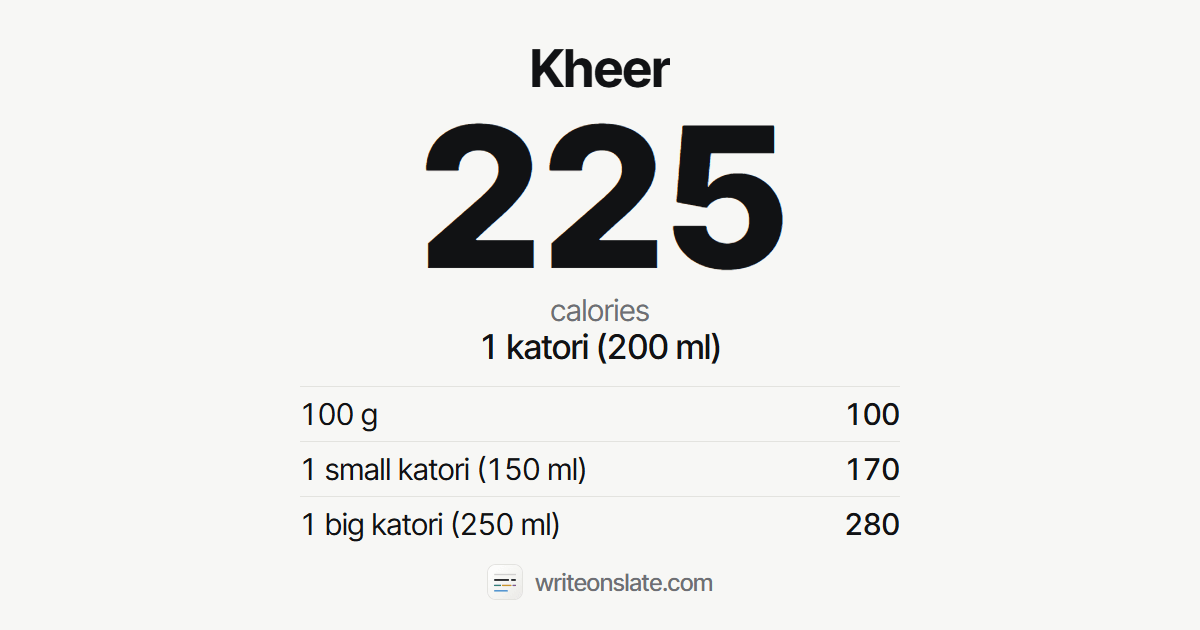
A 200 ml katori of home rice kheer, made with whole milk and 1½ tablespoons of sugar, has about 225 calories. A small 150 ml katori is about 170, a big 250 ml one about 280. Milk is more than half of it, sugar a quarter. A sweet-shop kheer, thicker and sweeter, runs about 225 to 300 a katori.
Kheer is rice simmered in milk until the milk thickens, sweetened with sugar and finished with cardamom, raisins and a few slivers of almond. It is the sweet of pujas and festival thalis across north India, and payasam, doodh pak and phirni are its cousins.
The number is set by the milk and the sugar, not the rice: a katori holds only a spoonful of rice. How far the milk is simmered down changes how much milk ends up in each katori.
Typical values for a home kitchen, for the portion named next to each number. Other sites often show bigger numbers because they count a bigger serving or a restaurant recipe. Your own katori, roti and oil change the number; Slate adjusts for them.
How many calories are in kheer?
| Portion | Cals | Protein | Carbs | Fat |
|---|---|---|---|---|
| 1 small katori (150 ml) about 165 g | 170 | 5 g | 22 g | 7 g |
| 1 katori (200 ml) about 220 g | 225 | 7 g | 30 g | 9 g |
| 1 big katori (250 ml) about 275 g | 280 | 9 g | 37 g | 11 g |
| 1 textbook bowl (the whole recipe, 300 g) about 300 g | 305 | 9 g | 40 g | 12 g |
| 100 g about 100 g | 100 | 3 g | 13 g | 4 g |
How does home kheer compare with outside?
Sweet-shop and wedding kheer is usually simmered down further, sweeter, and sometimes made with buffalo milk, khoa or condensed milk. USDA's firni, a thicker Indian milk pudding, has a third more calories per gram than its rice pudding.
The range below allows a katori up to a third richer than this recipe.
| Version | Cals | Fat |
|---|---|---|
| Home | 225 | 9 g |
| Sweet shop or restaurant | 225 to 300 | 9 to 12 g |
What changes the calories in kheer?
- Sugar is about a quarter of the number. Each tablespoon in the pot adds about 50 calories, spread over the bowls.
- How far the milk is simmered down: thicker kheer puts more milk, and more calories, into the same katori.
- Buffalo milk raises it by about half again on the milk's share; toned milk lowers it.
- Khoa, condensed milk or cream stirred in at the end adds a lot: a tablespoon of condensed milk is about 60 calories.
- Seviyan kheer and sabudana kheer are close to this per katori; gajar halwa is richer, about 145 for a small katori.
How were these numbers worked out?
The recipe is the rice kheer in The Art & Science of Cooking (via the Indian Nutrient Databank): 10 g of rice cooked in half a cup of water and 250 ml of whole milk, with 1½ tablespoons of sugar, raisins and almond, for one bowl, at IFCT 2017 values with sugar from USDA. The databank counts all the milk and water as still there, a thin kheer; this page takes them as simmered down to about 270 g, so the bowl is about 300 g, an assumption, and 100 calories per 100 g. A katori is measured by volume at USDA's rice pudding density of 1.1 g per ml, so a 200 ml katori is about 220 g and 225 calories. USDA's analysed rice pudding, 108 calories per 100 g, agrees within 5%. No sweet-shop kheer has been analysed; the range uses the ratio of USDA's firni to its rice pudding, 1.33 times. Every dish on Slate is worked out the same way: how Slate counts calories.
| Ingredient | Raw | Values from |
|---|---|---|
| Rice, parboiled, milled | 10 g | IFCT 2017 A014 |
| Milk, whole, cow 250 ml | 257.5 g | IFCT 2017 L002 |
| Sugar, white 1½ tablespoons | 18.9 g | USDA FDC 169655 |
| Raisins 4 to 5 | 1.5 g | IFCT 2017 E057 |
| Almond 1, slivered | 1.1 g | IFCT 2017 H001 |
| Water half a cup, to cook the rice; mostly simmered off | 120 g | no calories |
Sources
- ICMR-NIN, Indian Food Composition Tables 2017. Parboiled rice (A014), cow milk (L002), raisins (E057), almond (H001); values read from github.com/nodef/ifct2017
- Vijayakumar et al., Indian Nutrient Databank (INDB), Current Developments in Nutrition, 2024. The Art & Science of Cooking recipe ASC282, rice kheer (chawal ki kheer), 1 bowl
- Indian Nutrient Databank, recipes.xlsx, recipes_servingsize.xlsx and INDB.xlsx (GitHub). Recipe rows, serving size and units (sugar 4.2 g per tsp)
- USDA FoodData Central, FNDDS 2021-2023, Pudding, rice (2705685). 108 kcal, 3.23 g protein, 2.15 g fat, 18.39 g carbohydrate per 100 g; 1 cup = 260 g (read through the FDC search API)
- USDA FoodData Central, FNDDS 2021-2023, Firni, Indian pudding (2705686). 144 kcal per 100 g; used for the outside range (read through the FDC search API)
- USDA FoodData Central, Sugars, granulated (169655). Sugar; a teaspoon is 4.2 g and a cup 200 g
Questions people ask
How many calories are in 1 katori of kheer?
About 225 for a 200 ml katori of home rice kheer made with whole milk, and about 170 for a small 150 ml katori.
How many calories are in a bowl of kheer?
About 305 for the textbook bowl, the whole recipe of 250 ml of milk, or about 280 for a big 250 ml katori.
How much sugar is in kheer?
About 14 g of added sugar in a 200 ml katori of this recipe, plus about 8 g of the milk's own sugar.
How many calories are in 100 g of kheer?
About 100. USDA's analysed rice pudding is 108 per 100 g.
Which has more calories, a katori of kheer or a gulab jamun?
A katori of kheer, about 225, against about 155 for one gulab jamun. Two gulab jamuns come to about 310.