
Gujiya calories
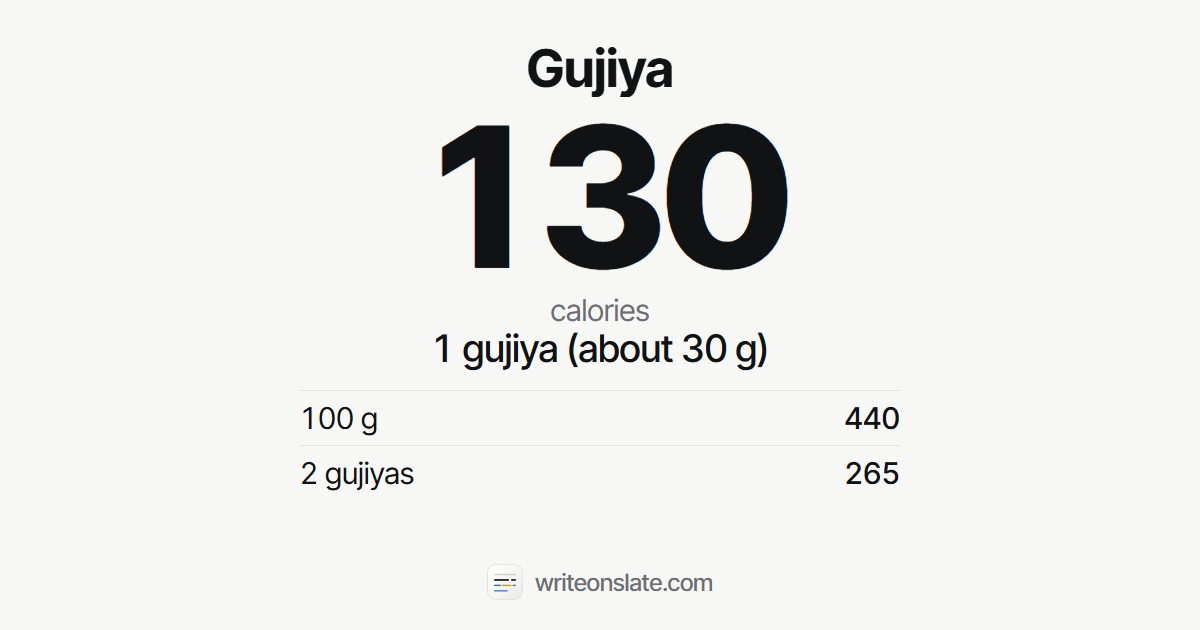
One home gujiya of about 30 g, a maida pastry filled with khoa, coconut and sugar and deep-fried, has about 130 calories; 2 about 265. The pastry and the oil it takes up are about half of that, the sweet filling the rest. A halwai gujiya, bigger and sometimes dipped in syrup, runs about 175 to 295.
Gujiya is a half-moon of maida pastry, filled with khoa, desiccated coconut, sugar and a few raisins, sealed with a crimped edge and deep-fried until crisp. Karanji in Maharashtra and ghughra in Gujarat are the same idea, often with more coconut. It is made at Holi and Diwali in north Indian homes.
The filling is sweet but small; the fried shell is where most of the calories are, as in a samosa.
Typical values for a home kitchen, for the portion named next to each number. Other sites often show bigger numbers because they count a bigger serving or a restaurant recipe. Your own katori, roti and oil change the number; Slate adjusts for them.
How many calories are in gujiya?
| Portion | Cals | Protein | Carbs | Fat |
|---|---|---|---|---|
| 1 gujiya (about 30 g) about 30 g | 130 | 2 g | 14 g | 8 g |
| 2 gujiyas about 60 g | 265 | 4 g | 27 g | 16 g |
| 100 g about 100 g | 440 | 7 g | 45 g | 26 g |
How does home gujiya compare with outside?
Sweet-shop gujiyas are usually bigger than home ones, 40 to 60 g, and many are dipped in sugar syrup after frying, which adds a coat of sugar. We found no lab figure for a gujiya of either kind.
The range below assumes a gujiya 1.33 to 2 times this size, with up to 8 g of syrup sugar on the larger one.
| Version | Cals | Fat |
|---|---|---|
| Home | 130 | 8 g |
| Halwai, larger or syrup-dipped | 175 to 295 | 10 to 16 g |
What changes the calories in gujiya?
- Size: a 60 g halwai gujiya has twice the calories of this 30 g one.
- Frying oil taken up is about a quarter of the number. Baked gujiya skips it, about 100 calories a piece from this recipe.
- A chashni dip adds sugar: a thin coat is 5 to 8 g, 20 to 30 calories.
- A coconut-heavy karanji filling is a little richer per gram than khoa; a mawa-only filling a little lighter.
- A samosa of the same pastry is about 165: the sweet filling and the savoury one come out close.
How were these numbers worked out?
The recipe is the gujia in The Art & Science of Cooking (via the Indian Nutrient Databank): 60 g of maida with 12 g of ghee and a tablespoon of water for the pastry, filled with 30 g of khoa, 10 g of desiccated coconut, 30 g of castor sugar, deep-fried, making 6, at IFCT 2017 values with sugar from USDA. The databank counts all 480 ml of frying oil as eaten, so this page takes the oil taken up as about 14% of the raw weight, the uptake worked out for the samosa on this site, about 3.7 g per gujiya; no lab has analysed gujiya itself. The batch is about 181 g and 440 calories per 100 g; one gujiya is a sixth, about 30 g and 130 calories, with no cross-check. The halwai range covers 40 to 60 g gujiyas with a chashni dip of up to 8 g of sugar. Every dish on Slate is worked out the same way: how Slate counts calories.
| Ingredient | Raw | Values from |
|---|---|---|
| Wheat flour, refined (maida) | 60 g | IFCT 2017 A018 |
| Ghee In the dough | 12 g | IFCT 2017 T013 |
| Water 1 tablespoon, to make the dough | 15 g | no calories |
| Khoa (mawa) | 30 g | IFCT 2017 L004 |
| Coconut, dry (copra) desiccated | 10 g | IFCT 2017 H006 |
| Raisins a few | 1.8 g | IFCT 2017 E057 |
| Sugar, white castor sugar, in the filling | 30 g | USDA FDC 169655 |
| Groundnut oil Taken up in frying: about 14% of the raw weight, as worked out for the samosa on this site (an assumption) | 22.2 g | IFCT 2017 T005 |
Sources
- ICMR-NIN, Indian Food Composition Tables 2017. Maida (A018), ghee (T013), khoa (L004), dry coconut (H006), raisins (E057); values read from github.com/nodef/ifct2017
- Vijayakumar et al., Indian Nutrient Databank (INDB), Current Developments in Nutrition, 2024. The Art & Science of Cooking recipe ASC347, gujia (lavang latika), 3 servings of 2
- Indian Nutrient Databank, recipes.xlsx, recipes_servingsize.xlsx and INDB.xlsx (GitHub). Recipe rows and serving count for ASC347
- Sakhale et al., oil uptake of lab-fried samosas (as used on the samosa page), and USDA FNDDS samosa. Frying oil taken up: about 14% of the raw weight, worked out on the samosa page from a fresh-oil lab study (18.3% fat) and USDA FNDDS (17.5 g fat per 100 g)
- USDA FoodData Central, Sugars, granulated (169655). Sugar; a teaspoon is 4.2 g and a cup 200 g
Questions people ask
How many calories are in 1 gujiya?
About 130 for a home gujiya of about 30 g, fried. A bigger halwai gujiya runs about 175 to 295.
How many calories are in 2 gujiyas?
About 265 for two home gujiyas.
How many calories are in a baked gujiya?
About 100 from this recipe: the same pastry and filling without the 3.7 g of frying oil, which is about 33 calories.
How much sugar is in a gujiya?
About 5 g of added sugar in the filling of one gujiya, plus the milk sugar in the khoa and a little from the raisins. A syrup-dipped one has more.
Is karanji the same as gujiya?
Close. Karanji is the Maharashtrian version, usually with a coconut and sugar filling and less or no khoa; ghughra is the Gujarati one. Per piece they are within a few calories of each other at the same size.