
Dhokla calories
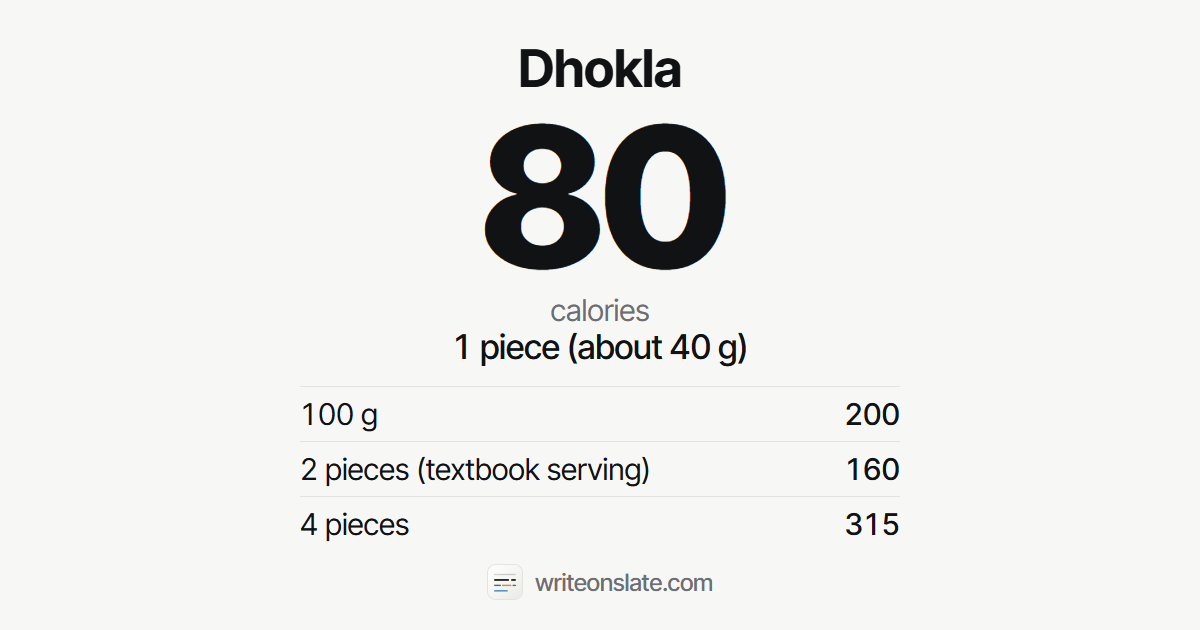
One piece of dhokla, about 40 g, has about 80 calories. Two pieces are about 160, 4 about 315, and a 250 g box about 500. The tempering matters most: a teaspoon of oil adds about 40, a teaspoon of sugar about 16. Farsan-shop khaman, soaked in its sweet tempering, runs about 215 to 270 for 2 pieces.
Dhokla, as most of India knows it, is the soft, yellow besan cake from Gujarat: gram flour and curd batter, leavened with soda and steamed, then tempered with mustard seeds, green chillies and curry leaves. In Gujarat the besan one is called khaman, and dhokla usually means a fermented rice and dal version.
It's steamed, so most of its calories come from the besan. Farsan shops pour a sweetened oil tempering over it, which adds more.
Typical values for a home kitchen, for the portion named next to each number. Other sites often show bigger numbers because they count a bigger serving or a restaurant recipe. Your own katori, roti and oil change the number; Slate adjusts for them.
How many calories are in dhokla?
| Portion | Cals | Protein | Carbs | Fat |
|---|---|---|---|---|
| 1 piece (about 40 g) about 40 g | 80 | 5 g | 10 g | 2 g |
| 2 pieces (textbook serving) about 79 g | 160 | 9 g | 19 g | 4 g |
| 4 pieces about 158 g | 315 | 19 g | 39 g | 9 g |
| 100 g about 100 g | 200 | 12 g | 25 g | 6 g |
| 250 g box about 250 g | 500 | 30 g | 62 g | 14 g |
How does home dhokla compare with outside?
Khaman from a farsan shop is usually soaked in a tempering of oil, sugar and water, which makes it moist and slightly sweet. It's often served with a sweet chutney too.
No lab has measured shop khaman, so the range below adds half to one teaspoon each of oil and sugar to each piece.
| Version | Cals | Fat |
|---|---|---|
| Home | 160 | 4 g |
| Farsan shop khaman | 215 to 270 | 9 to 13 g |
What changes the calories in dhokla?
- The tempering matters most. Each teaspoon of oil poured over adds about 40 calories, and each teaspoon of sugar about 16.
- Bigger pieces count for more: this page's piece is about 40 g.
- Sweet tamarind or date chutney adds about 60 calories a tablespoon; green chutney adds very little.
- Fermented rice and urad dhokla (white dhokla) and khandvi have their own values.
How were these numbers worked out?
The recipe is the dhokla in The Art & Science of Cooking (via the Indian Nutrient Databank): 150 g of besan and 150 g of curd with ginger, green chilli and soda, steamed and tempered with a teaspoon of oil and mustard seeds, cut into 8 pieces, the oil counted as eaten, at IFCT 2017 values with besan taken as ground Bengal gram dal and curd from USDA. Steaming keeps the water in, so the cooked weight is the ingredients added together, about 316 g, which makes a piece an eighth of that, about 40 g and 80 calories, and the batch 200 per 100 g. The databank's value for Basic Food Preparation's smaller khaman, in 6 pieces from soaked chana dal, is 18% lower per piece, so the page shows a range. The farsan shop range adds the sweet oil tempering poured over khaman, half to one teaspoon each of oil and sugar per piece. Every dish on Slate is worked out the same way: how Slate counts calories.
| Ingredient | Raw | Values from |
|---|---|---|
| Besan (ground Bengal gram dal) | 150 g | IFCT 2017 B001 |
| Curd (dahi), whole milk | 150 g | USDA FDC 171284 |
| Ginger, fresh | 6.3 g | IFCT 2017 G014 |
| Chillies, green | 3.3 g | IFCT 2017 G008 |
| Coriander leaves | 1 g | IFCT 2017 G009 |
| Mustard seeds | 0.8 g | IFCT 2017 H013 |
| Groundnut oil 1 teaspoon, for the tempering | 4.5 g | IFCT 2017 T005 |
Basic Food Preparation's khaman, made from soaked chana dal, comes to about 65 calories a piece, below this page's 80, because its pieces are smaller. Depending on size and tempering, a piece of dhokla is usually 65 to 100 calories.
Sources
- ICMR-NIN, Indian Food Composition Tables 2017. Bengal gram dal (B001) as besan, ginger, green chilli, coriander, mustard seeds, oil; values read from github.com/nodef/ifct2017
- Vijayakumar et al., Indian Nutrient Databank (INDB), Current Developments in Nutrition, 2024. The Art & Science of Cooking recipe ASC474, dhokla; Basic Food Preparation recipe BFP439, khaman
- USDA FoodData Central, Yogurt, plain, whole milk (171284). Curd
- ICMR-NIN, Dietary Guidelines for Indians: A Manual (2011). Annexure 8: tamarind chutney with jaggery 60 kcal per tbsp
Questions people ask
How many calories are in 1 piece of dhokla?
About 80 for a 40 g piece of besan dhokla, and more with a sweet tempering from a farsan shop.
How many calories are in 100 g of dhokla?
About 200, and about 500 for a 250 g box before the shop's tempering.
How much protein is in dhokla?
About 5 g in one piece and about 19 g in four, from the besan and curd.
Which has more calories, dhokla or idli?
Dhokla, per piece: about 80 against about 50 for a medium idli. Dhokla also has more protein.